Budget 2027 and Your First Home: What the Stamp Duty Exemption Actually Saves You — and Why Three in Five Loan Applications Still Fail
Relung · 2026-09-15
Budget 2027 will be tabled in Parliament on Friday, 9 October 2026. In the run-up, the property industry has started filing its wishlists — and two of them landed this month with specific, costed asks for first-time homebuyers.
If you are planning to buy your first home, the honest answer to "should I wait for the Budget?" is probably no. But not for the reason you would expect. The exemption everyone is campaigning to protect is already secure until the end of 2027. The thing that will actually decide whether you get the keys is sitting somewhere else entirely — and almost nobody is campaigning about it as loudly.
Here is what is on the table, what it is worth in ringgit, and the one number you should check before you sign anything.
What's actually being asked for
Two submissions this month set the agenda.
Juwai IQI (10 September) urged the government to extend the first-time homebuyer stamp duty exemption beyond its current expiry. Group co-founder and CEO Kashif Ansari put the exemption's reach at roughly 76% of all residential purchases in Malaysia, worth up to RM11,250 per transaction, at an estimated cost to the government of RM500 million to RM1 billion a year — inside a total budget of around RM419 billion. He also called for the Home Ownership Campaign (HOC) to be revived.
Knight Frank Malaysia (8 September) took a different angle. Group managing director Keith Ooi asked for the 8% foreign-buyer stamp duty to be standardised nationally rather than applied unevenly with separate Forest City treatment, and for Real Property Gains Tax (RPGT) relief for non-citizens to be extended across all Johor-Singapore Special Economic Zone flagship zones, not concentrated in Forest City alone. He also proposed a single unified affordable-housing framework, phased mandatory green certification, and a Singapore-style en bloc collective sale mechanism for ageing developments.
Neither is government policy. Both are lobbying documents. But they tell you what the industry expects to fight over on 9 October.
The RM11,250 question: what the exemption is actually worth
First, the mechanics, because most buyers never see them broken out.
When you buy a home in Malaysia as a citizen or PR, you pay stamp duty twice: once on the instrument of transfer (the MOT), and once on the loan agreement.
The transfer duty is tiered — each band is charged at its own rate, not the whole price at the top rate:
| Portion of purchase price | Rate |
|---|---|
| First RM100,000 | 1% |
| RM100,001 – RM500,000 | 2% |
| RM500,001 – RM1,000,000 | 3% |
| Above RM1,000,000 | 4% |
The loan agreement is a flat 0.5% of the amount financed.
The current exemption, extended under Budget 2026, gives first-time buyers a full exemption on both instruments for homes priced up to RM500,000, for sale and purchase agreements executed through 31 December 2027.
So what does that save you? Assuming a 90% margin of finance (illustrative — your actual loan margin will vary):
| Purchase price | Transfer duty | Loan agreement duty | Total saved by the exemption |
|---|---|---|---|
| RM300,000 | RM5,000 | RM1,350 | RM6,350 |
| RM400,000 | RM7,000 | RM1,800 | RM8,800 |
| RM450,000 | RM8,000 | RM2,025 | RM10,025 |
| RM500,000 | RM9,000 | RM2,250 | RM11,250 |
That RM11,250 at the ceiling is exactly the figure being quoted in the pre-budget commentary. It is real money — roughly two to three months of household income for a typical first-time buyer. But notice how quickly it falls away at lower prices. At RM300,000, the exemption is worth RM6,350, which is less than most buyers spend on legal fees, valuation, renovation and moving combined.
The cliff edge nobody warns you about
Here is the part that does not appear in any of the pre-budget commentary, and it matters more than the headline number.
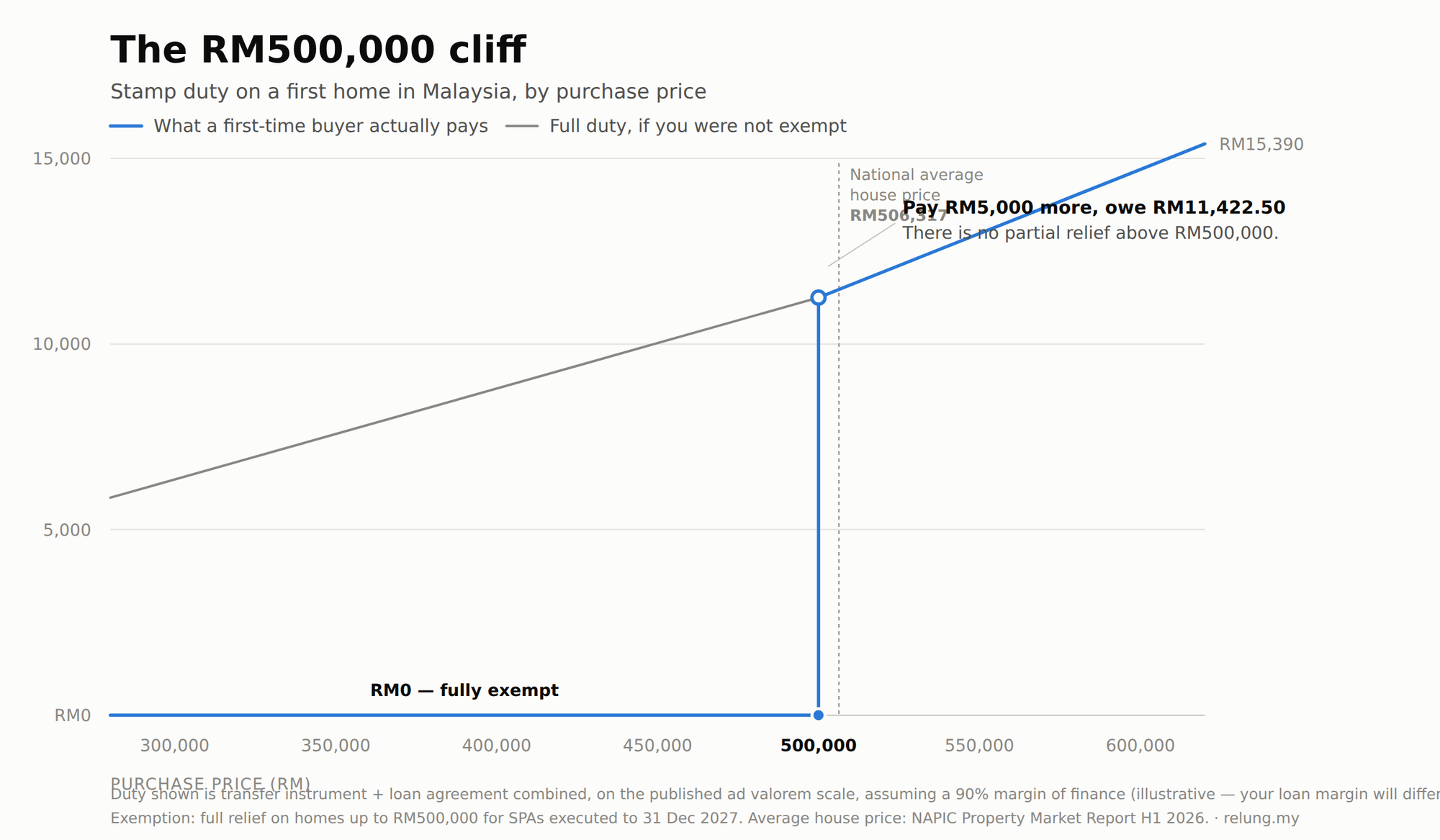
The exemption is a cliff, not a taper. There is no partial relief above RM500,000. Cross the line by one ringgit and you pay the full duty on the whole transaction.
| Purchase price | Duty payable | Note |
|---|---|---|
| RM500,000 | RM0 | Fully exempt |
| RM505,000 | RM11,422.50 | No exemption at all |
| RM520,000 | RM11,940.00 | No exemption at all |
Read that again. Agreeing to pay RM5,000 more for a unit — a rounding error in most negotiations, less than the cost of a decent kitchen — triggers RM11,422.50 in stamp duty you would otherwise not have paid. The true cost of that RM5,000 upgrade is RM16,422.50.
(Figures calculated on the published stamp duty scale, assuming a 90% margin of finance. Your loan margin and therefore your loan agreement duty will differ.)
If you are negotiating anywhere near RM500,000, this is the single most valuable thing to know before you sign. A seller holding out for RM510,000 on a property you valued at RM500,000 is not asking you for RM10,000. They are asking you for about RM21,500.
And this is no longer an edge case. NAPIC's H1 2026 Property Market Report, released on 10 September, put the average Malaysian house price at RM506,317 — now sitting just above the exemption ceiling. The average transacted home has quietly overtaken the threshold designed to help people buy one.
That average is pulled upward by high-value transactions, which is why around three-quarters of purchases still fall under RM500,000. But the direction of travel is clear: a ceiling fixed in ringgit erodes every year that prices rise. The Malaysian House Price Index rose 0.9% year-on-year in H1 2026. That is modest — but it is still one-way.
The bigger blocker: you can be exempted and still be rejected
Now the number that should reframe this entire debate.
In the same commentary, Juwai IQI noted that in the affordable-housing segment, three in five loan applications are rejected.
Sit with that. A buyer who qualifies for a full stamp duty exemption, saves RM11,250, and then cannot get financing has had the wrong problem solved. Stamp duty is a one-off cost at the point of transfer. Loan eligibility is the gate that decides whether you reach that point at all. For roughly 60% of applicants in the affordable segment, the gate is shut.
This is visible in the supply data too. NAPIC recorded 27,832 new residential units launched in H1 2026 with a sales performance of just 16.6% — meaning around five in six newly launched units did not sell during the period. Some of that is mispriced or badly located stock. A meaningful share of it is buyers who wanted to commit and could not get the loan.
So when you read that the industry is lobbying to protect the stamp duty exemption, understand what is being protected: a subsidy that only reaches people who already cleared the credit hurdle.
What to check before you shop: get an Approval-in-Principle from at least two banks before you commit to a unit, and look at your Central Credit Reference Information System (CCRIS) report first. Your debt service ratio — including car loans, personal financing and credit card balances — does more to determine your outcome than any Budget announcement will.
What a revived Home Ownership Campaign would, and wouldn't, do
Juwai IQI estimates that a revived HOC could save a young couple buying a RM450,000 first home around RM45,000 in total, of which roughly RM10,000 is stamp duty. Our own calculation on the published scale puts the stamp duty component at RM10,025 — which lines up.
The rest comes from the developer side: past HOCs required participating developers to offer minimum discounts on unsold stock in exchange for the duty concessions.
Two honest caveats. First, an HOC applies to developer stock, not subsale — so it does nothing for you if you are buying from an existing owner. Second, a "discount" from a developer's list price is only a discount if the list price was real. With 33,094 completed unsold homes and 23,375 unsold serviced apartments on the books as at H1 2026, some of that inventory is carrying an asking price the market has already declined to meet. Compare against recent transacted prices in the same development, not against the brochure.
REHDA president Datuk Zaini Yusoff also pressed for HOC's revival and for greater flexibility in housing financing at Mapex 2026 earlier this month — which tells you the developer lobby sees the financing bottleneck clearly, even if the stamp duty ask gets the headlines.
If you're buying in Johor or you're a foreign buyer
Knight Frank's asks matter most to two groups.
If you are a non-citizen buyer, the current position is an 8% flat stamp duty on the transfer, applied with carve-outs that differ by location. Knight Frank wants one published national rate. Predictability would help — but note that standardising a rate can mean it applies in places it previously did not.
If you are buying in the Johor-Singapore SEZ, the RPGT ask is the one to track. Extending RPGT relief for non-citizens across all flagship zones rather than Forest City alone would change the arithmetic for foreign investors across Iskandar Puteri, Pengerang and the other designated zones. Given that Johor already holds the largest residential overhang in the country — 4,222 completed unsold homes and 9,946 unsold serviced apartments — any measure that widens the foreign buyer pool there will be watched closely by owners trying to exit.
What to watch on 9 October — and what to do before then
Three things to look for in the Budget speech:
- Any extension of the stamp duty exemption beyond 31 December 2027, and critically, whether the RM500,000 ceiling moves. A ceiling raised to RM600,000 or RM700,000 would matter far more to Klang Valley and Penang buyers than a simple date extension.
- Anything on the financing side — guarantee schemes, margin of finance flexibility, or measures aimed at the rejection rate. This is where the real constraint sits.
- Whether HOC returns, and if so, whether it covers subsale or developer stock only.
And what to do now: the exemption runs to 31 December 2027, so there is no cliff to beat this year. That removes the urgency, but it does not remove the deadline — an SPA must be executed within the window, and the search, negotiation, loan approval and legal process ahead of that routinely takes three to six months. If you intend to use it, work backwards from the date.
Above all, if your budget is anywhere near RM500,000, price the cliff before you negotiate. That single piece of arithmetic is worth more than anything announced on 9 October.
Figures in this article are drawn from NAPIC's H1 2026 Property Market Report, Bank Negara Malaysia, the Ministry of Finance and industry commentary published in September 2026. Stamp duty calculations are our own, based on the published ad valorem scale and an assumed 90% margin of finance — clearly illustrative, since your loan margin will differ. This article is general information, not financial or legal advice. Confirm your position with your bank and your conveyancing solicitor before committing to a purchase.
Sources
- Malaysia property market remains resilient with RM105.12bil transactions in 1H 2026 — Amir Hamzah, *The Star*, 10 September 2026 (2026-09-10)
- Malaysia's unsold completed homes rise 8.6pc in H1 2026, *Malay Mail*, 10 September 2026 — https://www.malaymail.com/news/malaysia/2026/09/10/malaysias-unsold-completed-homes-rise-86pc-in-h1-2026-but-market-is-resilient-says-finance-minister-ii/234679 (2026-09-10)
- Budget 2027 commentary: Extend stamp duty exemption in Budget 2027, *BusinessToday*, 10 September 2026 — https://www.businesstoday.com.my/2026/09/10/budget-2027-commentary-extend-stamp-duty-exemption-in-budget-2027/ (2026-09-10)
- Commentary: Knight Frank — Malaysia's Budget 2027 wishlist, *BusinessToday*, 8 September 2026 (2026-09-08)
- Mapex 2026: KPKT pushes greener, data-led property planning, *EdgeProp.my*, 6 September 2026 — https://www.edgeprop.my/content/1917337/mapex-2026-kpkt-pushes-greener-data-led-property-planning (2026-09-06)
- Budget 2026: Stamp duty exemptions extended for homebuyers, *RinggitPlus*, 10 October 2025 — https://ringgitplus.com/en/blog/budget-2026/budget-2026-stamp-duty-exemptions-extended-for-homebuyers.html (2025-10-10)
- Pre-Budget Statement 2027, Ministry of Finance Malaysia — https://www.mof.gov.my/portal/en/news/press-release/pre-budget-statement-2027
- OPR Decisions, Bank Negara Malaysia — https://www.bnm.gov.my/monetary-stability/opr-decisions