The overhang everyone quotes is the wrong one
Malaysia's headline house-price numbers barely moved this half. The unsold stock underneath them moved a great deal — and it moved in a category that never appears in the residential overhang figure.
Relung · 2026-09-12
| Figure | H1 2026 | Change |
|---|---|---|
| Unsold completed serviced apartments | 23,375 units · RM19.33b | ▲ 24.7% |
| Unsold completed homes | 33,094 units · RM17.78b | ▲ 8.6% |
| Of those serviced apartments, in Johor | 9,946 units | 42.5% of national |
| Sales performance on 27,832 new launches | 16.6% | — |
On Thursday 10 September, Finance Minister II Datuk Seri Amir Hamzah Azizan launched NAPIC's Property Market Report for the first half of 2026 at Inspen in Kajang. The message from the podium was reassurance. The property market, he said, remained firm, supported by stable transaction activity and price movements.
The top-line numbers back him up. Malaysia recorded 187,320 property transactions worth RM105.12 billion in the six months to June. Residential property accounted for 110,998 of those deals — 59.3% of volume — and RM47.11 billion in value. The Malaysian House Price Index stood at 234.7 points. The average house price was RM506,317, up 0.9% year on year.
That last figure deserves a second look. With headline inflation averaging 1.8% over the first seven months of 2026, a 0.9% nominal rise means the average Malaysian home got slightly cheaper in real terms. Stable is not the same as healthy.
And then there is the stock nobody bought.
Two overhangs, and only one made the headlines
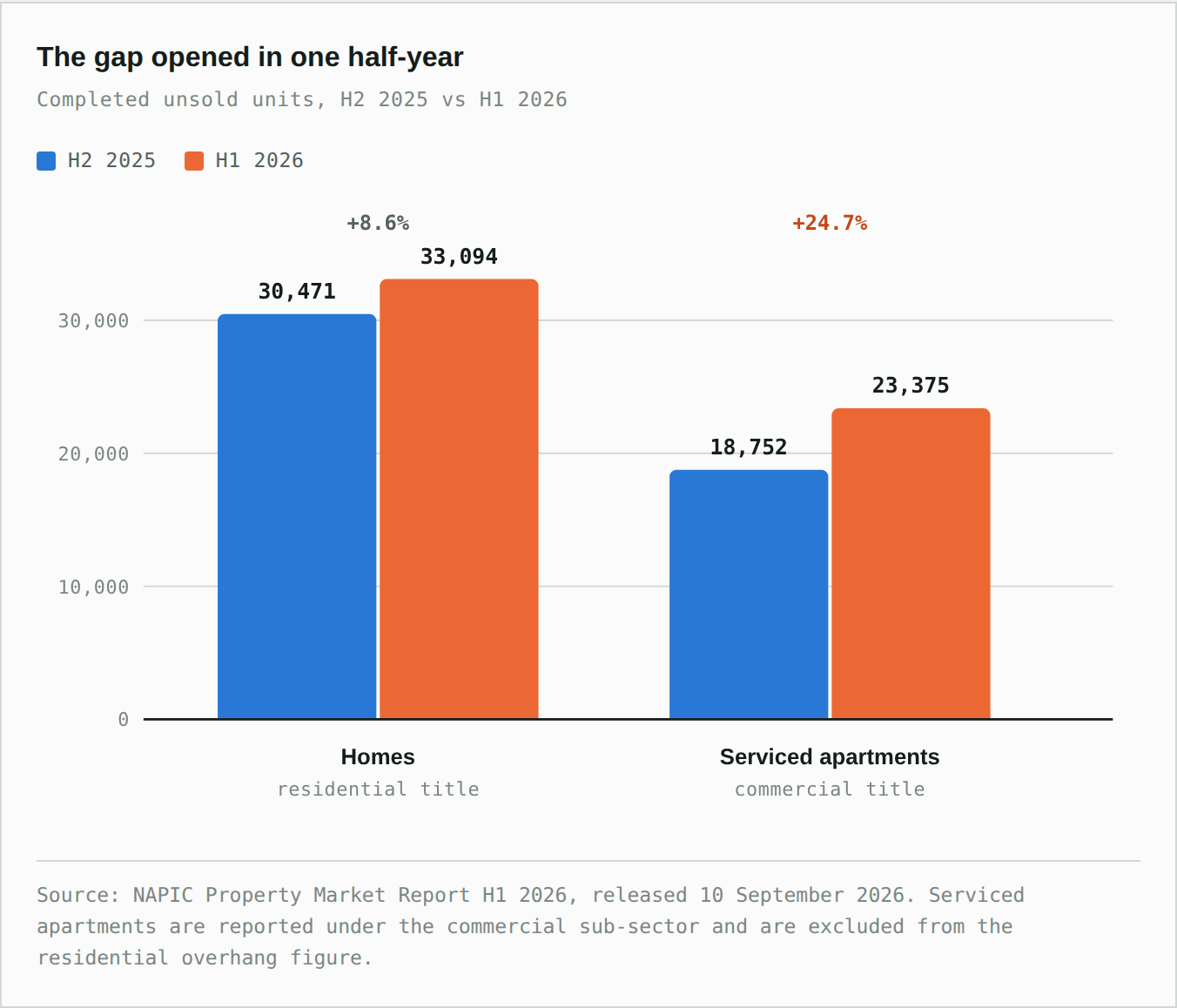
Completed unsold homes — the residential overhang, the number that gets quoted — rose 8.6% to 33,094 units worth RM17.78 billion, up from 30,471 units in the second half of 2025. That is a real deterioration, and it led most of the coverage.
It is not the number that should have.
Unsold completed serviced apartments rose 24.7% over the same half, to 23,375 units. By value the jump was steeper still: RM19.33 billion, up 25.4% from RM15.42 billion. In six months, Malaysia added roughly 4,600 finished serviced apartments that nobody has bought.
The value of Malaysia's unsold serviced apartments now exceeds the value of its entire residential overhang — RM19.33 billion against RM17.78 billion.
| Completed unsold units | H2 2025 | H1 2026 | Change |
|---|---|---|---|
| Homes (residential title) | 30,471 | 33,094 | ▲ 8.6% |
| Serviced apartments (commercial title) | 18,752 | 23,375 | ▲ 24.7% |
| Homes, by value | RM17.73b | RM17.78b | ▲ 0.3% |
| Serviced apartments, by value | RM15.42b | RM19.33b | ▲ 25.4% |
Serviced apartments are reported under the commercial sub-sector and are excluded from the residential overhang figure. Source: NAPIC Property Market Report H1 2026.
Put the two together and there are 56,469 completed, unsold units on the Malaysian market, carrying a combined value of RM37.11 billion.
Why serviced apartments disappear from the headline
The reason the bigger problem gets the smaller headline is a classification quirk that catches out a surprising number of buyers.
NAPIC reports serviced apartments under the commercial sub-sector, not the residential one. They are typically built on commercial land title, even though people live in them exactly as they would live in a condominium. So when a news report says "the residential overhang rose 8.6%", that figure of 33,094 units has already excluded every unsold serviced apartment in the country.
For an owner, the title is not a technicality. Commercial title generally means commercial rates for assessment and quit rent, and commercial tariffs for electricity and water — a standing cost gap against a residential-title unit in the same neighbourhood that compounds every year you hold it. Lenders also size these units differently, which narrows the pool of buyers you can eventually sell to.
None of that is new. What is new is the scale: this is now a RM19.33 billion category of finished, empty, commercially-titled housing, growing at nearly three times the rate of the residential overhang beside it.
It is also much older stock than the residential overhang. 71.1% of unsold serviced apartments were launched between six and ten years ago, against 38% of unsold homes — so the category growing fastest is also the one that has already had longest to sell and failed.
Johor's split personality
Johor holds the most unsold completed homes in the country, at 4,222 units. It also holds the most unsold serviced apartments, at 9,946.
The second number is the one that matters. It is 42.5% of the entire national serviced-apartment overhang, concentrated in a single state.
Now set that against everything else that happened in Johor over the past week.
| What capital actually bought in Johor this week | |
|---|---|
| RM199.8m | AME Elite to acquire 176.5 acres at Jeram Batu, Pontian, inside the Johor–Singapore Special Economic Zone |
| RM858m | Kerjaya Prospek wins a data centre M&E fit-out contract in Iskandar Puteri — its largest ever |
| RM263.21m | Crescendo collects the balance on 52.544 acres of Kota Tinggi industrial land sold for data centre use, about RM115 psf |
| RM214.5m | Centurion Corp to buy a 7,974-bed workers' accommodation complex in Pasir Gudang |
Nationally, data centre land transactions reached RM2.45 billion across 568 acres in the first half of 2026, against RM464 million across 92 acres in the second half of 2025 — roughly 37% of all land acquisition value Knight Frank tracked in the period.
Johor's boom is real. But read that list again: land, power infrastructure, fit-out contracts, and beds for construction workers. The money is going into industrial Johor. Very little of it is going into the two- and three-bedroom serviced apartments that were sold on the promise of it — and the clearest evidence is that when a listed company needed to house nearly eight thousand workers in Pasir Gudang this week, it bought a purpose-built dormitory complex rather than absorbing any part of the 9,946 empty units down the road.
Who is still launching into this
27,832 new residential units were launched nationwide in the first half of 2026. 16.6% of them sold.
That is NAPIC's "sales performance" measure, and it means roughly five in six newly launched homes were still unsold at the end of June. Johor launched 6,697 of them — second only to Selangor's 8,354, and ahead of Penang's 2,878.
The composition of what is already stuck tells you why new supply is not clearing it.
| Characteristic of the 33,094 unsold completed homes | Share |
|---|---|
| High-rise | 43.4% |
| Launched six to ten years ago | 38.0% |
| Priced at RM300,000 and below | 37.3% |
| Terraced houses | 34.9% |
Categories overlap — each is a share of the same 33,094 units, not a segment of it. Source: NAPIC H1 2026.
Two things in that table should stop you. First, 38% of the overhang was launched between six and ten years ago. This is not recent supply that merely needs time; it is aged inventory that has failed to sell through an entire property cycle.
Second, 37.3% of it is priced at RM300,000 and below — while the largest segment of new launches nationwide was RM500,001 to RM1 million, at 10,853 units or 39% of the total.
Read together, those two facts kill the easiest explanation. If more than a third of unsold homes are already in the cheapest price band and still are not moving, the binding constraint is not the sticker price. It is location, product, build quality, or the buyer's ability to get a loan at all. Meanwhile the new supply is being built a full price band above the stock that is already stuck.
And in serviced apartments, new supply is being built directly into the glut. 55.2% of the unsold serviced apartments are priced between RM500,001 and RM1 million — the same band taking the largest share of new launches nationwide.
Developers are not blind to this, and their bankers are less so. At the REHDA Institute conference on 8–9 September, OCBC Bank Malaysia's managing director for real estate corporate banking, Mohammad Fadzli Ahmad, told the room that pricing a project above comparable developments on a per-square-foot basis measurably reduces its odds of winning project financing. Most projects, he said, need better than 85% of units sold simply to break even, and construction costs have been climbing since April 2026.
One more number frames all of this. Bank Negara held the Overnight Policy Rate at 2.75% on 3 September, with the economy having grown 5.7% in the first half. Financing is not expensive by recent standards. If cheap credit, a growing economy and a 0.9% price rise have not cleared 56,469 completed units, the problem was never the interest rate.
What to do about it
Buying. Ask for the title before you ask for the price. Residential or commercial changes your assessment, quit rent, utility tariffs and your eventual buyer pool — and in a JB serviced apartment, all four at once. Then ask what year the project was launched: if it falls in that six-to-ten-year band, you are looking at a building the market has already had a long time to judge.
Selling. In these buildings your competition is not the other owners — it is the developer's own unsold units in the same block. A developer can offer rebates, absorb legal fees and package furnishings in ways you cannot match. Price against their effective net price, not against their advertised one.
Investing. This is the strongest negotiating position buyers have had in years, but only in one narrow category and mainly in one state. That is a reason to be selective, not a reason to be brave. An asset that 9,946 other people are also trying to exit is a liquidity problem before it is a yield problem.
Letting. Johor's tenant demand is real, but it is being created by construction and data centre workforces — and it is being met by purpose-built accommodation like the Pasir Gudang complex. Do not assume industrial job growth flows through to investor-grade condo rentals. Check who is actually signing your tenancy agreements.
Agents. The 16.6% sales performance figure is your talking point for the whole second half. It gives you a defensible, sourced reason to have a hard pricing conversation with a vendor who is still anchored to 2019 numbers.
Where the market is actually tight
None of this is a verdict on Malaysian property as a whole, and the same NAPIC release makes that clear.
Industrial property recorded 3,932 transactions worth RM14.78 billion, with the segment growing 3.8%. Office occupancy improved to 78.5% from 77.8% a year earlier. Shopping complex occupancy slipped slightly, to 77.9% from 78.7%.
The pattern is consistent across every line of the report. Where the demand is industrial — factories, logistics, data centres, the land under them and the beds beside them — capital is being absorbed, and it is being absorbed quickly. Where the demand was assumed to be investor appetite for high-rise residential, it is not.
Malaysia's property market is not soft. It is sorted. The half-year data simply made the sorting visible, and it put four in ten of the consequences in one state.
Sources
- Malay Mail — NAPIC Property Market Report H1 2026, reported in "Malaysia's unsold completed homes rise 8.6pc in H1 2026, but market is resilient, says Finance Minister II (2026-09-10)
- The Star — Malaysia property market remains resilient with RM105.12bil transactions in 1H 2026 — Amir Hamzah (2026-09-10)
- New Straits Times — Malaysia property market remains resilient with RM105.12bil transactions (2026-09-10)
- EdgeProp.my — Pricing properties too high may hamper financing approval — developers (2026-09-10)
- Bank Negara Malaysia — Monetary Policy Statement (2026-09-03)
- The Star — "DC investments shift value" (Knight Frank data centre land transaction data) (2026-09-04)
- The Star — AME Elite to acquire 176.5 acres in JS-SEZ for RM199.8mil (2026-09-10)
- EdgeProp.my — Kerjaya Prospek lands RM858m Johor data centre job (2026-09-04)
- EdgeProp.my — Crescendo receives balance payment for RM263m Johor data centre land sale (2026-09-09)
- EdgeProp.my — Centurion’s RM214.5m Pasir Gudang buy to be its largest in Malaysia (2026-09-09)