One number sets your maintenance fee and your AGM vote
The Housing Department is weighing whether to pull those two apart, and to bill maintenance by floor area instead. In a mixed development, that would quietly move money from the shops to the flats.
Relung · 2026-09-13
Ask any Malaysian condominium owner what they find least explicable about strata living and a version of the same complaint comes back: why does the unit next door, roughly the same size, pay a different maintenance fee? Or the sharper version, in a mixed development — why am I subsidising a shopping podium I never walk through?
The answer is a single number attached to your parcel called an allocated share unit. On 10 September, at the Strata Property Management Seminar 2026 at Sunway Resort Hotel in Petaling Jaya, an official from the National Housing Department said the government is considering taking that number apart.
Maizatul Izzah Mohd Shamsudin, senior assistant director of the department's Strata Management Division, set out a review of the Strata Management Act 2013 that would separate the mechanism deciding your maintenance charge from the one deciding your vote — potentially removing share units from the Strata Titles Act altogether, building a replacement inside the SMA, and apportioning maintenance by strata area instead.
Before anything else, her own caveat, which deserves to travel with every report of this: "A proposal in this presentation should not be understood as an amendment or as set in stone because we are still refining the amendment proposal." Nothing here is law. Nothing has been tabled. Which is precisely why it is worth understanding now, while the shape of it can still be argued about.
What a share unit actually is
Share units are not a rough proxy for size, though most owners assume they are. They come out of a formula in the Strata Titles Act 1985, and the formula is deliberately weighted.
Share units = (A × F₁ × F₂) + (B × F₃)- A — Floor area of your parcel
- B — Area of any accessory parcel, typically your car park bay
- F₁ — Weightage for what the parcel is used for
- F₂ — Weightage for floor level and whole-floor status
- F₃ — Weightage for the accessory parcel
F₁ is where the real force sits. It is not one figure but a band, and where a parcel lands inside its band turns on things like whether common corridors and lobbies are air-conditioned and whether there are lifts or escalators to run.
Table: Parcel-type weightage (F₁)
| Parcel type | Weightage |
|---|---|
| Apartment / SoHo | 1.00 – 1.30 |
| Retail complex | 2.00 – 3.20 |
| Hotel / medical suite | 2.20 – 2.80 |
| Car park | 1.00 – 1.45 |
| Industrial | 1.00 |
Indicative ranges under the share-unit formula guidelines. Position within each band depends on factors including lift and escalator provision and centralised air-conditioning of common areas. Some states apply their own ratios for mixed developments.
So a retail lot can carry more than twice the share units of an apartment of identical floor area — and since the Act requires charges to be levied in proportion to allocated share units, it carries more than twice the maintenance bill.
Two features of this system cause most of the trouble. The first is that it does two entirely different jobs at once: your share units set your bill and your voting weight at the AGM. The second is the one Maizatul singled out. Share units are fixed early, in the schedule of parcels filed before a single unit is sold, and cannot be changed once strata titles are registered — no matter how the common facilities or their actual use change over the following thirty years.
What happens if maintenance follows floor area
Strip out the weightages and bill by strata area alone, and the arithmetic moves. Here is a simplified scheme to show the direction and rough size of that move.
Take a mixed development with 100 apartments and 10 retail lots, every parcel 1,000 sq ft, and a monthly maintenance budget of RM100,000. Give the apartments an F₁ of 1.10 and the retail lots 2.40.
Table: The same scheme, billed two ways
| Apartment | Retail lot | |
|---|---|---|
| Floor area | 1,000 sq ft | 1,000 sq ft |
| Weightage (F₁) | 1.10 | 2.40 |
| Share units today | 1,100 | 2,400 |
| Share of the budget today | 0.82% | 1.79% |
| Monthly charge today | RM821 | RM1,791 |
| Monthly charge by strata area | RM909 | RM909 |
| Change | +10.7% | −49.2% |
Illustrative figures using the share-unit formula and indicative weightages, not a real development. Aggregate share units 134,000; total strata area 110,000 sq ft. The budget is unchanged in both columns — only its apportionment moves.
Chart: Who pays more, who pays less Monthly maintenance charge per parcel, illustrative mixed scheme.
| Parcel | Today, by share units | If billed by strata area |
|---|---|---|
| Apartment (1,000 sq ft) | RM821 | RM909 |
| Retail lot (1,000 sq ft) | RM1,791 | RM909 |
Illustrative scheme, not a real development. Same total budget of RM100,000 a month in both cases — area-based apportionment redistributes it rather than reducing it.
Apportioning by area does not make maintenance cheaper. It moves who pays, and in a mixed development it moves it towards the homes.
That is the part worth sitting with before anyone cheers. "Fairer" is doing a lot of work in this debate, and which answer counts as fair depends entirely on whether you think a shopping podium should pay more because it generates more wear, more security cost and more lift traffic — or the same as a flat because it occupies the same floor area.
In a purely residential block the effect is much milder. Where every parcel shares one F₁ band, share units already track floor area fairly closely, and the difference between the two methods narrows to the floor-level and accessory-parcel weightings.
The courts got there first
What makes this review more than a technical tidy-up is that Malaysian courts have spent seven years pulling at the same thread, and have already arrived somewhere the statute did not obviously anticipate.
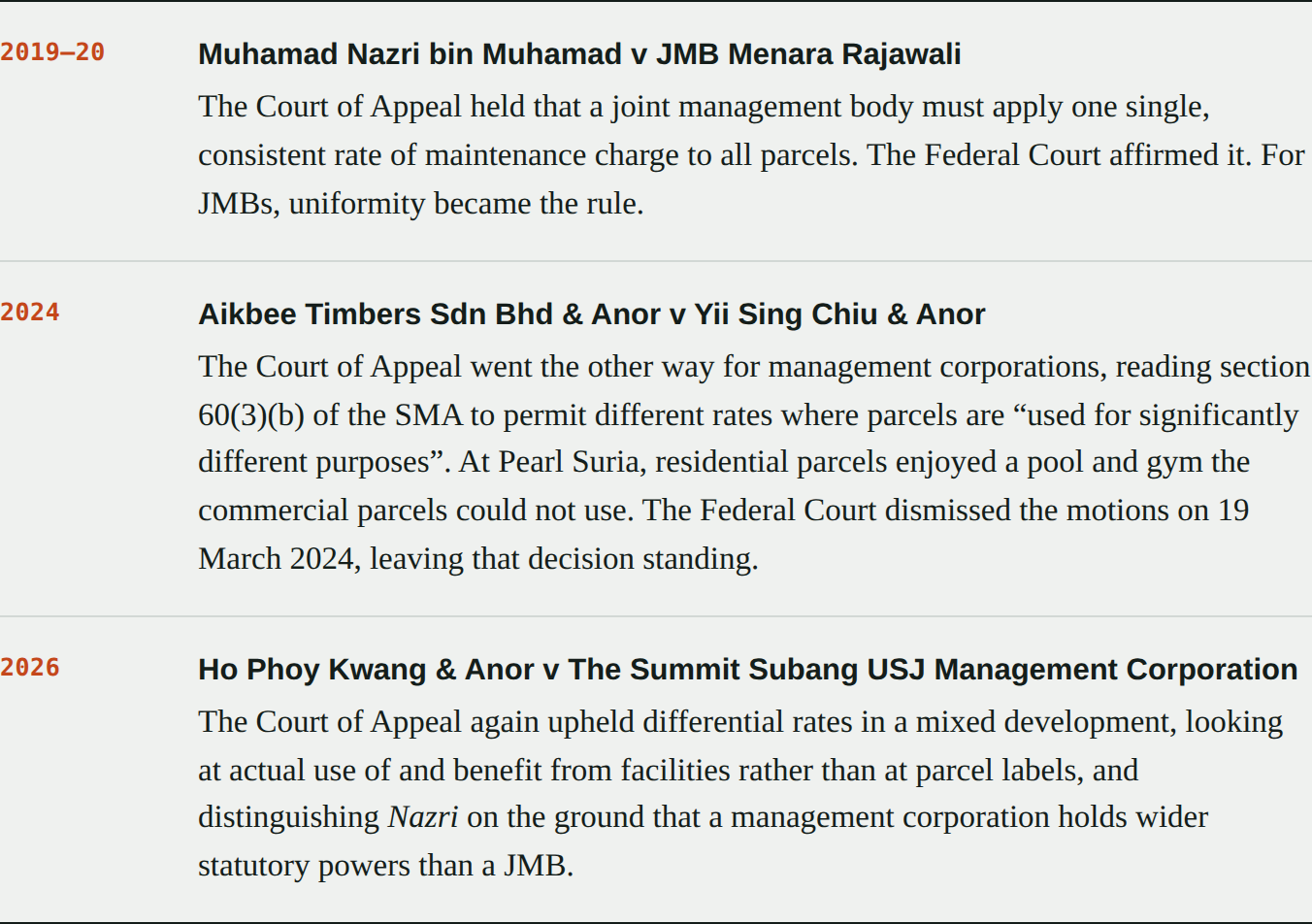
**2019–20 — Muhamad Nazri bin Muhamad v JMB Menara Rajawali** The Court of Appeal held that a joint management body must apply one single, consistent rate of maintenance charge to all parcels. The Federal Court affirmed it. For JMBs, uniformity became the rule.
**2024 — Aikbee Timbers Sdn Bhd & Anor v Yii Sing Chiu & Anor** The Court of Appeal went the other way for management corporations, reading section 60(3)(b) of the SMA to permit different rates where parcels are "used for significantly different purposes". At Pearl Suria, residential parcels enjoyed a pool and gym the commercial parcels could not use. The Federal Court dismissed the motions on 19 March 2024, leaving that decision standing.
**2026 — Ho Phoy Kwang & Anor v The Summit Subang USJ Management Corporation** The Court of Appeal again upheld differential rates in a mixed development, looking at actual use of and benefit from facilities rather than at parcel labels, and distinguishing Nazri on the ground that a management corporation holds wider statutory powers than a JMB.
The upshot is a split that no owner would guess from reading the Act. If your building is still run by a JMB, one rate for everyone. Once it converts to a management corporation, differential rates become available — where they can be justified by significantly different purposes, and where they are just and reasonable.
Seen against that, the Housing Department's review looks less like an idea out of nowhere and more like the legislature catching up with a doctrine the courts have already built.
The half nobody is discussing: your vote
Almost all the attention has gone to the money. The more consequential half of the proposal is the other one.
Today your share units are your voting weight. Decouple the two, and every general meeting in the country is re-weighted. Consider who currently holds large-area, high-weightage parcels: developers with unsold stock, commercial owners of podium lots, hotel operators in integrated schemes. Under the present system they carry a heavy bill — and a correspondingly heavy vote, including on the budget that sets that bill.
There is a rough justice in that pairing. You pay the most, you have the most say. Break it, and the obvious question becomes: what should the vote follow instead? One parcel, one vote would hand decisive control to the numerous small residential owners. Floor area would sit somewhere between. Each answer redistributes power in a different direction, and none is neutral.
Why this matters more than it sounds Malaysia has roughly three million strata parcels across some 27,000 schemes, and the country's urbanisation rate has gone from 28% in 1970 to about 78% today, with 85% projected by 2040. Strata is not a niche tenure here; it is increasingly the default way Malaysians live. Collection is already the sector's chronic weakness. Industry estimates put maintenance-fee collection rates at 40–50% in low-cost schemes, 60–70% in medium-cost, and 80–95% at the high end. Any reform that raises the bill on residential parcels lands on the part of the market that is least able to pay it.
What to do while this is still a draft
Owners. Find your share units. They are in the schedule of parcels and on your strata title, and most owners have never looked. Divide yours by the scheme's aggregate and you have your exact share of every budget your JMB or MC passes — and your exact voting weight. You cannot argue about a reform to a number you have never checked.
Mixed schemes. If you own in a development with a retail or hotel component, work out now what an area-based split would do to your line of the budget. Residential owners in these schemes are the group with most at stake, and they are currently the quietest in the consultation.
JMBs and MCs. Know which side of the Nazri / Aikbee line you are on before you set next year's rates. A JMB imposing differential charges is on unsafe ground; an MC doing so needs a documented, defensible justification tied to actual use and benefit, not to parcel type alone.
Buyers. Ask for the share units and the current rate per share unit before you sign, not the headline monthly figure. In a mixed development, also ask whether the scheme is under a JMB or an MC — it determines whether your charge can lawfully differ from the shop below you.
STATUS OF THIS PROPOSAL Everything described here is a departmental proposal presented at a seminar, expressly described by the official presenting it as still being refined and not ready for Parliament. The Strata Management Act 2013 amendment is expected to reach Parliament next year as part of the National Housing Policy 2026–2035 legislative package, alongside three new acts. Until then, the existing share-unit system and the case law above govern your building.
Share units have been asked to do two jobs since 1985, and for a market of walk-up flats they did both adequately. In an era of integrated schemes stacking homes on malls on hotels above a shared car park, one weighted number can no longer carry both your bill and your ballot. Splitting them is probably right. Which is exactly why it matters who gets to decide what each half attaches to — and that argument is still open.
Sources
- EdgeProp.my — Strata Management Act 2013 review considers changes to maintenance charges, voting rights (2026-09-10)
- Conveyancing Practice Committee — "Significance of share units in strata development" (the share-unit formula and its weightage factors)
- iProperty.com.my — What is a schedule of parcels, and how to use the share unit formula
- Chee Hoe & Associates — "Calculating rates of and share units" (parcel-type weightage ranges)
- ) — "Can a management corporation impose different rates of maintenance charges and sinking fund?" (*Aikbee Timbers Sdn Bhd & Anor v Yii Sing Chiu & Anor*, section 60(3)
- Messrs Koo Jia Hung — "Federal Court ruled that developer and management corporation can impose different rates of charges" (Federal Court disposal of the *Aikbee Timbers* motions, ) (2024-03-19)
- MahWengKwai & Associates — "Single rate of maintenance charges applies to management corporations" (*Muhamad Nazri bin Muhamad v JMB Menara Rajawali*)
- Conventus Law — "One development, different maintenance rates? The Court of Appeal clarifies a management corporation's powers" (*Ho Phoy Kwang & Anor v The Summit Subang USJ Management Corporation*)
- Bernama — "Maintenance fee arrears: should we be concerned?" (collection rates by scheme type) (2025-03-11)
- Bernama — "Tiga akta baharu, satu pindaan di bawah Dasar Perumahan Negara 2026–2035" (strata unit and urbanisation figures; the SMA amendment in the legislative package) (2026-08-10)