No payslip, no problem. No house, though.
The new National Housing Policy points gig workers at a government loan guarantee that genuinely works without a payslip. The catch is not the paperwork — it is the price cap at the other end.
Relung · 2026-09-12
If you drive for Grab, sell on TikTok, freelance, run a warung or take commission-only work, you have probably been told the same thing at a bank counter: come back with three months of payslips. This week the Ministry of Housing and Local Government said, in effect, that you should not have to.
KPKT launched the National Housing Policy — Dasar Perumahan Negara 2026–2035, six focus areas, 17 strategies and 59 action plans — and singled out youths and gig workers as a group the housing market has been quietly excluding. The route it points them to is the Housing Credit Guarantee Scheme, better known by its Malay initials, SJKP.
"The Government wants to make sure young people who want to own their first home are not left behind," said KPKT deputy secretary-general Zulkeflee Sulaiman. Minister Nga Kor Ming has separately said SJKP is targeting 100,000 beneficiaries by the end of this year.
In the same briefing, KPKT said something else that has had far less attention. The RM300,000 figure Malaysia has used for years as the national definition of an "affordable" home is being dropped as a blanket benchmark. J. Murali, undersecretary of KPKT's housing planning division, said affordability varies too much between states for one number to work, and that location-specific benchmarks — built on local income, purchasing power and transport costs — will replace it.
Hold those two announcements next to each other, because they do not quite agree.
What SJKP actually does
The most common misunderstanding first: SJKP does not lend you money.
Syarikat Jaminan Kredit Perumahan Berhad is a company wholly owned by the Minister of Finance (Incorporated), set up in December 2007. What it does is stand behind your loan. If you default, the government pays the bank. That changes the bank's arithmetic — it is no longer taking the full risk on an applicant it cannot assess the usual way — which is why a lender that would not touch an irregular income will consider it under SJKP.
Three practical consequences follow, and all three surprise people.
You do not apply to SJKP. You apply at a participating bank, and the bank requests the guarantee on your behalf. Walking into SJKP's office achieves nothing. Second, SJKP charges the borrower no fee for the guarantee — if someone is asking you to pay for access to the scheme, that is not how it works. Third, the bank still underwrites you. A guarantee makes you assessable, not automatically approved.
Two tiers, and the one everybody gets wrong
SJKP is not one scheme. There are two, and which one you fall into decides where you are allowed to go house-hunting.
Table: SJKP and SJKP MADANI, side by side
| SJKP (standard) | SJKP MADANI | |
|---|---|---|
| Maximum property price | RM500,000 | RM300,000 |
| Maximum financing | RM500,000 | RM360,000 |
| Margin of financing | up to 110% of value | up to 120% of value |
| What the margin above 100% covers | Mortgage insurance, legal fees, valuation, renovation and furnishing | (same) |
| Down payment | Not required | Not required |
| Maximum tenure | 35 years, or to age 70 — whichever comes first | (same) |
| Fee charged by SJKP to you | None | None |
Sources: SJKP scheme pages and Maybank's published SJKP product page, September 2026. Parameters are set by SJKP and applied by each participating bank — confirm current terms with your lender before relying on them.
That "up to 120%" line is the most useful thing in the table, and it is why the scheme matters more than a headline about payslips suggests. A conventional 90% loan means finding a 10% deposit plus legal fees, valuation, stamp duty and MRTA out of savings — on a RM300,000 home, comfortably RM40,000 in cash. SJKP MADANI can cover the purchase price in full and up to 20% on top for exactly those costs, plus renovation and furnishing.
For someone with irregular income, the deposit was almost always the harder wall of the two. This scheme removes it.
The gap nobody mentioned this week
Now put the price caps on a scale next to what Malaysian houses actually cost.
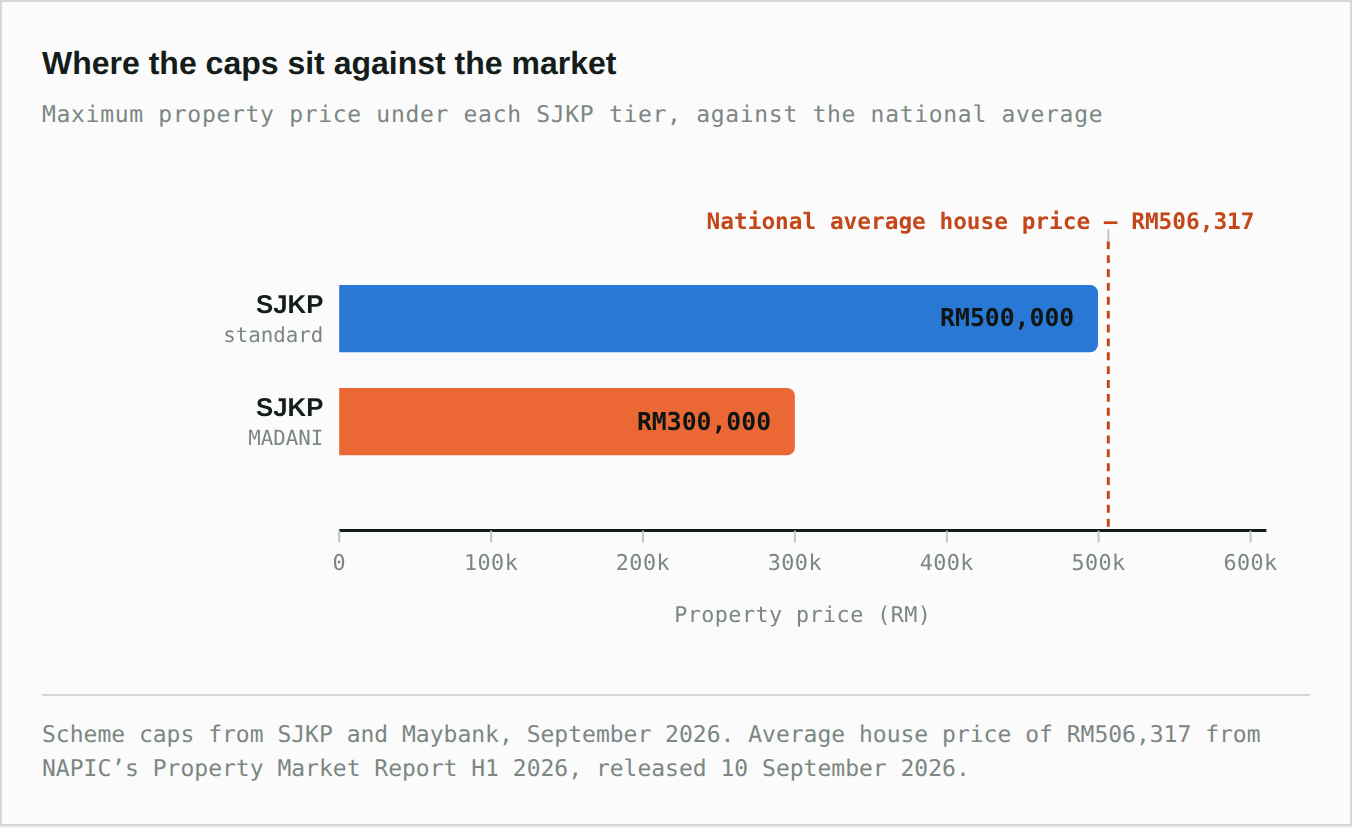
Chart: Where the caps sit against the market Maximum property price under each SJKP tier, against the national average.
| Marker | Value |
|---|---|
| SJKP MADANI — maximum property price | RM300,000 |
| SJKP (standard) — maximum property price | RM500,000 |
| National average house price | RM506,317 |
Scheme caps from SJKP and Maybank, September 2026. Average house price of RM506,317 from NAPIC's Property Market Report H1 2026, released 10 September 2026.
The standard SJKP cap is RM500,000. The average Malaysian house price, per the NAPIC half-year report released two days earlier, is RM506,317.
The scheme built to get first-time buyers into the market tops out RM6,317 below the average house in it.
And the tier aimed squarely at the buyers this week's announcement was about — gig workers, informal earners, the ones without payslips — caps out at RM300,000. Which is precisely the number KPKT said, in the same briefing, no longer works as a national benchmark.
So the policy has arrived at an awkward position: the affordability definition is being localised because officials accept RM300,000 means very different things in Kuala Lumpur and in Kelantan, while the financing instrument for the lowest-income buyers is still pegged to RM300,000 everywhere.
There is one more number worth putting beside those. NAPIC's same report found that 37.3% of Malaysia's 33,094 unsold completed homes are priced at RM300,000 and below. So there is stock in the MADANI band — a great deal of it. What there is not, on the evidence of it sitting unsold, is stock in that band that people actually want to live in. A guarantee that unlocks financing for a house in the wrong place does not solve very much.
None of which makes the scheme a bad deal. It makes it a narrow one, and the narrowness is about geography and price, not about your income documents.
What you actually need if you have no payslip
This is the part the announcements skip, so here it is concretely. Banks substitute two things for a payslip: a tax filing, and a bank trail.
In place of payslips — what a participating bank asks for
- Your latest one-year Form B or BE, or the e-filing acknowledgement. This is the single document that does the most work. If you have never filed, this is the reason to start — and it means a wait.
- Six consecutive months of your business or company current account statements — or six months of commission statements if you earn on commission.
- Supporting validation: an EPF statement, financial accounts, or personal bank statements.
- NRIC and proof of marital status, plus the sale and purchase agreement or booking receipt once you have chosen a property.
The practical lesson inside that list is one most gig workers learn too late: if your income runs through the same account as your groceries, a bank cannot read it. Six clean months of a separate business account is worth more to your application than a higher income in a messy one.
The eligibility conditions that apply either way
- Malaysian citizen, 18 or older. Two-generation financing is allowed, and joint applications with immediate family are permitted.
- First-time home buyer, and the property must be for owner-occupation — every party on the SPA is expected to be an occupier.
- New, completed, sub-sale or auctioned residential property. Land purchases and self-build financing are not covered.
- Total repayments across all your debts must not exceed 65% of gross monthly income.
- No CCRIS arrears exceeding two months in the past 12 months, and no adverse credit records in the past 24.
- An income ceiling of RM11,000 a month per applicant, as stated on participating banks' product pages.
- Fire insurance or takaful is compulsory.
CHECK BEFORE YOU COMMIT Scheme parameters are set by SJKP and applied by each participating bank, and they have been revised more than once since 2019. Every figure here was current in September 2026, but confirm the cap, margin and documentation with the bank taking your application — not with a property agent, and not with a WhatsApp forward.
What is still only a promise
Most of what was announced this week is a plan rather than a rule, and it is worth knowing which is which.
SJKP exists now and you can walk into a bank tomorrow. The localised affordability benchmarks do not exist yet — KPKT has approval from the Finance Ministry for the big-data model that will produce them, and has said the resulting data will be opened to developers for feasibility studies, but no replacement number has been published.
Further out sit three new laws the policy commits to drafting: a Property Development Act extending oversight beyond housing into commercial projects, a Building Managers Act aimed at the roughly three million strata units across some 27,000 schemes, and a Residential Tenancy Act to set out landlord and tenant rights. The Strata Management Act 2013 is to be amended alongside them, with the amendment expected in Parliament next year. The wider policy targets one million affordable homes by 2035.
The nearer date to watch is 9 October 2026, when Budget 2027 is tabled. The Finance Ministry's pre-budget statement in August confirmed the stamp duty exemption for first-time buyers continues; if that saving is material to your purchase, the thresholds are worth checking on budget day before you sign anything.
What to do this month
- Pull your own CCRIS report first. Free from Bank Negara's eCCRIS portal. A forgotten phone bill or a two-month lapse on a motorcycle loan in the past year is the most common silent rejection, and it is the one thing on this list you can still fix by waiting.
- Get one year of tax filings in order. Form B if you are self-employed, BE if not. If you have never filed, file now and accept that your application waits for it. Nothing else substitutes.
- Open a separate account for your income. Then leave it alone for six months. You are building the bank trail that replaces your payslips, and it needs to be legible.
- Work out your own 65% ceiling. Add up every existing commitment, then see what is left inside 65% of gross monthly income. Do this before you view anything — it sets your budget more firmly than any scheme cap.
- Know which tier you are shopping in. RM300,000 or RM500,000. That single number decides which neighbourhoods are open to you, and it is better faced at the start than at the bank.
The honest summary is this. Malaysia has built a genuinely good answer to the payslip problem, and this week it finally said out loud who it was built for. The answer it has not built yet is a house that answer can buy in the city where the work is.
Sources
- Malay Mail — No payslip, no problem: New housing policy targets gig workers (2026-09-11)
- The Star — "Housing Ministry submits tax incentive proposal to boost green buildings" (SJKP 100,000-beneficiary target; localised affordability model) (2026-09-05)
- EdgeProp.my — "Mapex 2026: KPKT pushes greener, data-led property planning" (Finance Ministry approval for the housing big-data model) (2026-09-06)
- Syarikat Jaminan Kredit Perumahan Berhad — Housing Credit Guarantee Scheme MADANI — scheme features
- SJKP — Kelayakan permohonan SJKP (eligibility criteria, 65% debt service ratio, CCRIS conditions)
- SJKP — SJKP frequently asked questions (application route, no borrower fee, eligible property types)
- SJKP — About SJKP (ownership by Minister of Finance Incorporated, established December 2007)
- Maybank Malaysia — Skim Jaminan Kredit Perumahan (tier caps, margins, income ceiling, self-employed documentation)
- Bernama — Tiga akta baharu, satu pindaan di bawah Dasar Perumahan Negara 2026–2035 (2026-08-10)
- Dewan Ekonomi — DRN 2026–2035 sasar satu juta rumah mampu milik menjelang 2035 (2026-08-10)
- The Star — NAPIC Property Market Report H1 2026 (average house price RM506,317; 33,094 unsold completed homes; 37.3% priced at RM300,000 and below) (2026-09-10)
- Ministry of Finance — Pre-Budget Statement 2027 (Budget 2027 tabling on ; continuation of first-home stamp duty exemption) (2026-08-18)